
We treat our homes as sanctuaries of comfort and modern convenience. We shut the doors, turn up the air conditioning, light a scented candle, and settle into our favorite sofa. But could the very spaces designed to protect and comfort us actually be harbouring hidden threats to our health?
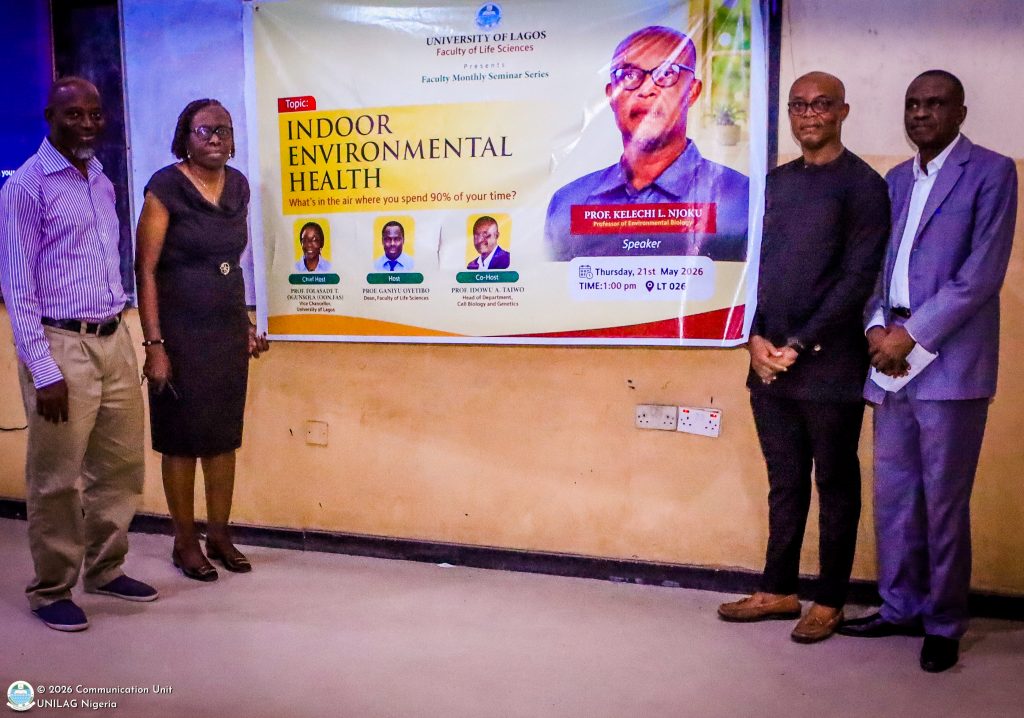
That was the compelling question at the heart of the University of Lagos Faculty of Life Sciences’ Monthly Seminar Series, held on Thursday, May 21, 2026, at the Lecture Theatre (LT026), Science Complex.
Delivering a deeply eye-opening presentation titled “Indoor Environmental Health,” Professor. Kelechi L. Njoku challenged attendees to look beyond the aesthetics of modern living. In an era dominated by remote work and tightly sealed architecture, Professor Njoku warned that indoor air quality and chemical safety have rapidly escalated into critical public health battlegrounds.



The Architecture of Confinement: The Trap of Modern Living
Does the comfort and conduciveness of modern homes always translate to better health? Professor Njoku asked the audience, sparking immediate reflection. He explained that contemporary lifestyle shifts mean humans now spend a staggering majority of their time indoors. Compounding this issue is modern architectural design, where narrow windows, permanently shut doors, and a heavy reliance on air conditioning have drastically reduced cross-ventilation. Instead of keeping the bad air out, modern buildings are effectively trapping a toxic cocktail of pollutants inside our living and working spaces, encouraging the rapid accumulation of invisible dangers from everyday household materials.



From ‘Sick Buildings’ to Everyday Electronics
For many, the office environment isn’t much safer than the home. Professor Njoku shed light on Sick Building Syndrome (SBS), describing it as a collection of symptoms linked directly to the time spent inside certain structures. Occupants trapped in these environments frequently battle a cluster of debilitating symptoms, including chronic headaches, dizziness, nausea, and fatigue. This syndrome also manifests physically as eye, nose, throat, and skin irritation, alongside shortness of breath and chest tightness. The toll is not just physical; individuals often experience thermal and noise-related discomfort, which ultimately triggers heightened psychological stress.
Bringing the crisis close to home, Professor Njoku shared compelling data from localized studies conducted right within the University of Lagos environment, examining the indoor particulate matter and microbial loads in campus offices. The findings underscore that indoor pollution is not a distant, theoretical problem, but a local reality. He noted that the biological contaminants harboring in these spaces: ranging from animal dander, dust mites, and cockroach particles to bacteria, viruses, pollen, mould, and mildew – regularly contribute to allergic reactions, respiratory distress, infectious diseases, and toxic effects on organs and tissues.



Furthermore, the rise of remote work has exacerbated these vulnerabilities. While working from home offers advantages like improved work-life balance and reduced commuting time, prolonged indoor enclosure is extracting a heavy toll.
Professor Njoku warned that this lifestyle increases isolation, poor posture, and eye strain while severely reducing physical activity. He cited studies linking excessive television viewing and prolonged electronic device usage to obesity, type 2 diabetes, decreased self-efficacy in maintaining personal health, and even reproductive risks in experimental models.
The Hidden Toxins in Your Decor and Routine
The lecture meticulously deconstructed the invisible chemical threats lurking in everyday consumer products. Fragranced products, which many use to make indoor environments more pleasant, such as air fresheners, deodorizers, perfumes, personal care items, cleaning supplies, laundry products, and scented candles, frequently compromise indoor air quality. Rather than simply refreshing a room, they can trigger severe health complaints including migraine headaches, mucosal symptoms, skin reactions, cognitive difficulties, gastrointestinal complaints, and cardiovascular discomfort.
Another major area addressed was the widespread use of flame retardants added to furniture, electronics, textiles, mattresses, carpets, building materials, and even children’s items to delay fire. Prof. Njoku explained that these chemicals routinely leach into household dust, food, water, and the wider environment. This exposure spans several hazardous categories, including brominated, nitrogen-containing, organophosphate, and inorganic flame retardants, all of which are linked to serious endocrine, reproductive, neurological, respiratory, immune, and developmental health concerns.



Similarly, volatile organic compounds (VOCs) represent a massive chemical hazard due to how easily they turn into gases or vapours at room temperature. Released from everyday items like paints, adhesives, aerosol sprays, disinfectants, moth repellents, fuels, dry-cleaned clothes, and pesticides, VOCs pose immediate and long-term risks. Exposure can cause immediate eye, nose, and throat irritation, headaches, nausea, and allergic skin reactions, while prolonged exposure carries serious long-term risks of liver damage, kidney damage, central nervous system impairment, and elevated cancer risks.
Danger in the Kitchen: Cooking and Plastics
Even the simple act of preparing a meal can turn hazardous, as the presentation drew urgent attention to pollutants generated during indoor cooking. The lecture highlighted how gas burners release nitrogen dioxide, while poorly ventilated appliances emit dangerous carbon monoxide. Frying and burning food releases high levels of particulate matter, overheated oils generate acrolein, and grilling or charring foods produces polycyclic aromatic hydrocarbons. Furthermore, high-temperature cooking methods routinely unleash volatile organic compounds, benzene, and formaldehyde, emphasizing that cooking methods heavily influence both the nutritional quality of food and the generation of harmful contaminants.


The threat extends from the stove to the pantry, with Professor Njoku discussing bisphenols and alkylphenols as critical household exposures. Bisphenols like BPA, BPS, and BPF are heavily utilized in plastics and resins, while alkylphenols are found in fragrances, tyres, adhesives, and fire-retardants. Humans regularly absorb these chemicals through food, water, dust, air, and skin contact, allowing them to interfere directly with hormonal systems. Proving the immediate local relevance of this issue, Prof. Njoku referenced academic studies on canned foods sold in Nigeria, which revealed significant chemical contaminants in everyday consumer products.
Rounding out the chemical rogue’s gallery was the pervasive threat of microplastics. Defined as plastic particles less than 5 mm in size, microplastics are increasingly found infiltrating household items, indoor air, water supplies, and food, often released directly from kitchen equipment and tools.
Call to Action
As the lecture concluded, the message was clear: the indoor environment can no longer be taken for granted. While modern amenities provide undeniable luxury and convenience, Professor Kelechi Njoku asserted that human health must remain the ultimate priority. Since people spend the vast majority of their lives indoors, the home can easily become a quiet but significant source of exposure that erodes public health.
To combat this silent indoor epidemic, the Faculty of Life Sciences called for an immediate shift in public awareness and everyday habits. The seminar closed with an urgent recommendation for improved natural ventilation through better cross-airflow, a shift toward safer and fragrance-free product choices, and cleaner household and cooking practices. Finally, Professor Njoku emphasised the critical need for more robust, dedicated research into indoor environmental exposures specifically within the Nigerian context, ensuring that science continues to bridge the gap between academic discovery and everyday survival.

Report: Isaiah Kumuyi
Photographs: Joshua Michael OgoOluwa