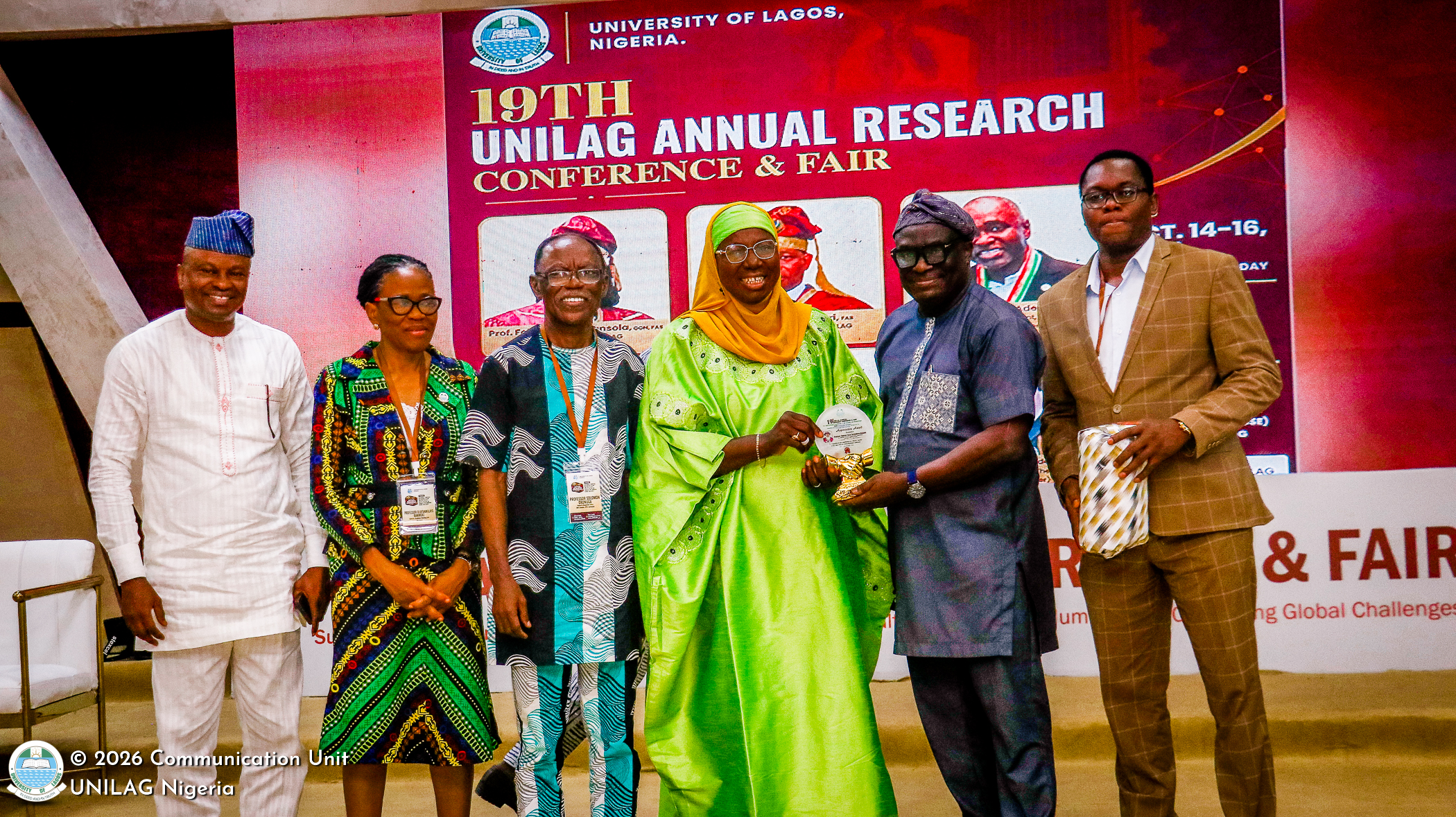
The Vice-Chancellor of the University of Applied Science, Engineering and Technology (USET), The Gambia, Professor Nazmat Toyin Surajudeen-Bakinde, on Friday, October 16, 2026, commended the University of Lagos (UNILAG) for its milestone in entrepreneurship education, particularly through its Entrepreneurship, Innovation and Business Incubation Certification (EIBIC) programme.
Her commendation followed the Federal Government’s recognition and adoption of the UNILAG EIBIC programme as a model for institutionalising entrepreneurship certification in Nigerian universities.
Professor Surajudeen-Bakinde made the remarks while delivering the plenary presentation during the morning session of Day Three of the 19th UNILAG Annual Research Conference and Fair, held at the Jelili Omotola Multipurpose Hall, UNILAG.


Her presentation, titled “The Role of Engineering, Innovation and Universities in Tackling Global Challenges,” formed part of the activities marking the final day of the three-day conference, themed “Sustainable Frontiers: Integrating Systems for Food Security, Health, Housing and Humanity for Combating Global Challenges.”
She highlighted the relevance of the theme of the 6th UNILAG International Week, noting that universities must prepare learners for an increasingly competitive world of work shaped by artificial intelligence (AI), climate change, energy insecurity, unemployment and rapid technological advancement.


Addressing the relationship between engineering, technology and technical education, the USET Vice-Chancellor advocated entrepreneurship education as a means of equipping learners with the skills to identify opportunities, validate problems, mobilise resources, experiment, understand markets and create value responsibly.
Emphasising the need for engineering to respond to societal realities, she said African universities must strengthen their capacity to adapt technologies and develop homegrown solutions rather than rely solely on imported innovations.
She called for innovation ecosystems that enable ideas to progress from conception to prototyping, validation, refinement, adoption, production, financing and long-term sustainability. Innovation, she stressed, should not be confined to annual events or competitions but should become an integral part of institutional processes, linking teaching, research, industry engagement, and enterprise development.


According to her, Africa needs more technically competent graduates who can identify opportunities, mobilise resources, understand customers, manage risks, and translate their capabilities into economic and social value.
She further advocated closer integration of entrepreneurship education with engineering and technology. Engineers equipped with knowledge of costing, market validation, and productivity, she explained, are better positioned to translate innovations into practical applications, while entrepreneurs with an understanding of technology can improve products and processes.


Highlighting the complementary roles of key stakeholders in driving innovation and development, the plenary speaker said governments must provide enabling policies and public infrastructure; industry must contribute production expertise, market insights and investment discipline; communities must identify problems requiring solutions; financial institutions must provide funding; and universities must contribute knowledge, experimentation, talent and evidence.
She urged African universities to look beyond the number of graduates produced and publications generated when assessing their impact. Instead, she called for greater emphasis on the number of societal problems solved, technologies transferred from laboratories into practical use, enterprises strengthened through university engagement, and products, processes, and services developed. She also underscored the importance of assessing how effectively graduates apply their acquired knowledge.

According to her, the future of higher education depends on aligning teaching methods, research, and institutional practices with the demands of development.
“Universities of the future must not simply prepare students to fit into the world as it exists; they must give them the capacity and confidence to improve it,” she said.
She explained that African universities must reimagine teaching as active problem-solving, research as a source of usable knowledge, engineering as a development capability, entrepreneurship as a discipline of value creation, and innovation as a system for translating ideas into impact.
She added that 21st-century universities must create learning environments in which students apply knowledge to interpret problems, test possibilities, and develop solutions. This, she explained, requires exposing students to real-world challenges from industry, communities, and public institutions while encouraging interdisciplinary collaboration, evidence-based decision-making, experimentation, learning from failure, and an understanding of end users.


Earlier, the Deputy Vice-Chancellor, Management Services, Professor Muyiwa Falaiye, who represented the Deputy Vice-Chancellor, Academics and Research, Professor Matthew Ilori, commended the quality of resource persons across the plenary and oral sessions of the conference.


Expressing confidence that participants would leave the conference better equipped with new insights and professional connections, Professor Falaiye urged them to apply the knowledge gained to improve their research and enhance its practical impact.
He also appreciated the organising committee and subcommittees, as well as all those who contributed to the successful hosting of the 19th UNILAG Annual Research Conference and Fair.


The conference commenced on Wednesday, October 14, 2026, bringing together scholars and industry leaders to explore integrated solutions to global challenges. Read more about the 1st day of the conference and fair via: https://lagosedu.com/19th-unilag-annual-research-conference-fair-scholars-industry-leaders-seek-integrated-solutions-to-global-challenges/ and https://lagosedu.com/unilag-intl-week-2026-stakeholders-explore-industry-academia-collaboration-at-research-conference-fair/.
On Thursday, October 15, 2026, the conference continued with a plenary session at which featured the Provost of the University of Birmingham, UK, Professor Nick Vaughan-Williams. Read more: https://lagosedu.com/19th-unilag-research-conference-uk-academic-hails-partnership-driving-advances-in-global-surgery-patient-safety/.
Report: Gbenga Gbelee
Photograph: Michael Joshua